- Published on
Robot Dogs: From Novelty to Necessity
- Authors

- Name
- Sopha Kingtyred
- @kingtyred
There is a particular kind of clarity that comes from watching a technology stop being a curiosity and start being infrastructure. Robot dogs have crossed that threshold. They are no longer the blinking, stumbling party tricks that made crowds gasp at tech conferences. They are guarding data centers, patrolling World Cup stadiums, carrying missiles, and — in what may be the most culturally precise moment of our era — printing photographs of Elon Musk out of their rear ends at a Berlin art museum. The robot dog has arrived. The only question worth asking now is where it goes from here.
The Gimmick Is Dead
For years, Boston Dynamics' Spot was the robotics world's most expensive conversation piece. Corporations would lease one, film it opening a door, post the video, and call it innovation. That era is over.
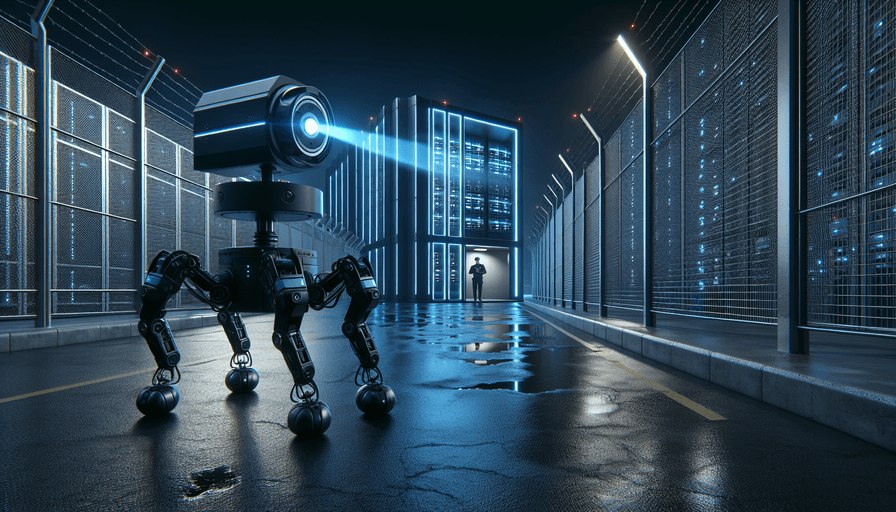
Robot dogs priced at $300,000 are now being deployed to guard major data centers, and operators are reporting positive returns on investment. That sentence should stop you cold. A $300,000 machine guarding a data center is not a stunt. It is a capital allocation decision made by serious people with spreadsheets. When the finance department signs off on a robot dog, the gimmick phase is definitionally over.
The economics, it turns out, are not as absurd as they sound. If Boston Dynamics' pricing drops to $100,000 at scale — which analysts consider plausible — the operational cost works out to roughly $5.10 per hour. That is below the US federal minimum wage of $7.25 and dramatically below the $20–$38 hourly wages common in automotive plants. 1
This is not a technology story anymore. It is a labor economics story wearing a robot suit.
A Market Growing Up
The numbers confirm what the anecdotes suggest. The global AI robot dog market is projected to grow from $1.5 billion in 2026 to $2.83 billion by 2035, at a compound annual growth rate of 7.3%. That is not explosive, Silicon Valley-style hyperbolic growth. It is the steady, grinding expansion of something becoming genuinely useful — the kind of growth that does not attract breathless headlines but does attract institutional investors.
Two players dominate the hardware landscape, and they could not be more different from each other. Boston Dynamics is the Western pioneer: premium-priced, carefully deployed, and increasingly essential to enterprise clients. Unitree is China's hardware champion: aggressively priced (models starting at $4,900), with a broader product portfolio and a faster release cadence enabled by China's manufacturing infrastructure. 2
Chinese manufacturers currently account for the vast majority of approximately 13,000 units shipped globally in 2025. Volume belongs to Unitree. Prestige, for now, belongs to Boston Dynamics. Both are winning.
The applications expanding beyond security read like a list someone generated by asking "where do humans not want to go?": oil and gas inspection, semiconductor fabrication facilities, elder care, logistics, and defense. These are not glamorous deployments. They are practical ones, which is precisely the point.
The World Is Watching — Literally
The cultural footprint of robot dogs is expanding as fast as the market. At the 2026 World Cup in Mexico, robot dogs are confirmed to be patrolling the grounds — an event watched by billions. MSC Cruises has incorporated robot dogs into its 2026 entertainment lineup. And China, with the blunt directness that characterizes its military technology program, has armed robot dogs with missiles.
That last development deserves more than a passing mention. A quadruped robot platform is inherently flexible — it can carry sensors, cameras, LiDARs, acoustic arrays, and, now, weapons. The same physical architecture that makes a robot dog useful for inspecting a gas pipeline makes it adaptable for military applications. This is not a hypothetical future concern. It is a present reality.
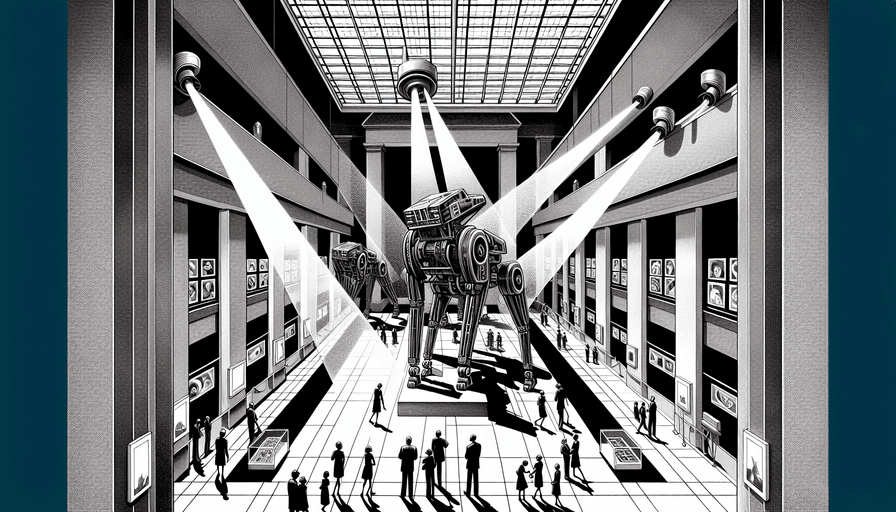
Meanwhile, in Berlin, artist Beeple is making the most culturally legible argument about all of this. His installation Regular Animals — a pack of semi-autonomous robot dogs fitted with hyper-realistic silicone faces of tech billionaires and artists including Elon Musk, Mark Zuckerberg, Jeff Bezos, Andy Warhol, and Pablo Picasso — will take over the foyer of Neue Nationalgalerie from April 29 to May 10, 2026. The robots photograph visitors, process the images through AI filters styled after each figure (Picasso's output emerges fractured into cubist forms; Musk's arrive as stark technical diagrams), and then print the photographs — ejecting them from their rear ends for visitors to take home.
It is absurd. It is precise. It is the most efficient artistic statement about surveillance capitalism, algorithmic mediation, and the tech-billionaire industrial complex that I have encountered in years. The curator at Neue Nationalgalerie put it plainly: "Technology is currently one of the most powerful forces shaping our lives, our economies, our politics, and even our sense of identity and reality. Cultural institutions cannot remain outside of that conversation."
Dogs Teaching Robots, Robots Teaching Us
The most quietly remarkable development of the past week came not from a product launch or a military demonstration, but from a university lab. On March 13, 2026, researchers at Brown University published a study showing that robots can achieve an 89% success rate in object retrieval by combining human language with pointing gestures — a methodology directly inspired by dog cognition research.
The research, led by graduate student Ivy He and presented five days later at the International Conference on Human-Robot Interaction in Edinburgh, used a probabilistic framework (a POMDP system) that fuses vision-language models with geometric gesture modeling — essentially teaching robots to interpret the same multimodal signals that dogs have been reading from humans for thousands of years. The irony is complete: we built robot dogs, and now we are teaching them to behave like real ones.
This matters beyond the lab. An 89% success rate in cluttered, real-world environments is the kind of number that moves something from research curiosity to practical deployment candidate. Home assistants, warehouse workers, elder care companions — the applications cascade naturally from that single statistic.
The Product Landscape Matures
Nine different quadruped robots are now available for purchase in 2026. Nine. The market has moved from a duopoly demonstration to a genuine product category. Unitree continues to expand its Go2 and B2 lines. Vbot debuted its autonomous "Super Robot Dog" at CES with a global launch planned for Q2 2026. And Hyundai — which arrived at CES 2025 with its Atlas humanoid robot and watched its stock surge 80% in two weeks — is investing $6.3 billion in a dedicated robot factory, signaling that the world's automakers have recognized robotics not as a side project but as a survival strategy. 1
The progression from nine purchasable models in 2026 to whatever number exists in 2030 will not be linear. It will follow the familiar technology curve: rapid product differentiation, price compression, a shakeout that eliminates the weakest players, and then a new equilibrium at a dramatically lower price point with dramatically higher capability.
What Comes Next
The robot dog market is not going to announce itself with a single dramatic moment. It is going to accumulate — one data center contract, one World Cup patrol, one elder care facility deployment at a time — until the question is no longer "should we use robot dogs?" but "which robot dog should we use?"
The technology is ready. The economics are compelling. The cultural conversation, from Beeple's Berlin installation to China's missile-armed platforms, has already begun. What remains is the unglamorous work of integration, standardization, and the quiet expansion of trust between humans and the four-legged machines we have built in the image of our oldest companions.
That expansion is already underway. The dogs are out of the kennel.