- Published on
NASA's Moon Program: A Beautiful Mess Gets a Makeover
- Authors

- Name
- Mike Rotchberns
- @MRotchberns
Here we are again. Another week, another headline about NASA's Artemis program either breaking something, rolling something back into a garage, or reshuffling a deck of mission cards that nobody asked to be reshuffled. And yet — and I say this through gritted teeth — the changes announced on February 27th, 2026 might actually be the most sensible thing NASA has done with this program in years. So pour yourself something strong, because we're going to talk about rockets.
The Rollback Nobody Wanted
Let's start with the immediate embarrassment, because there's always one.
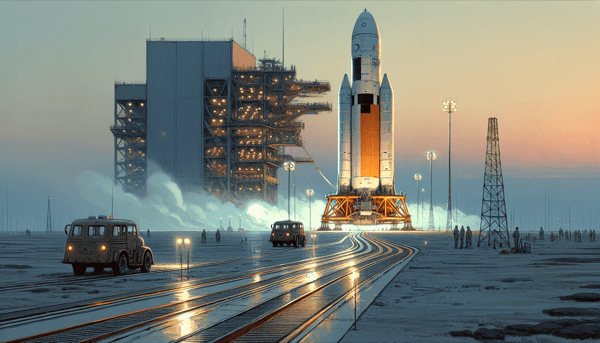
On February 25th, 2026, NASA's Space Launch System (SLS) rocket and Orion spacecraft were rolled back from Launch Pad 39B to the Vehicle Assembly Building — a 322-foot monument to American ambition making a slow, humiliating retreat on a crawler vehicle originally built for the Apollo program. The culprit this time: a helium flow interruption in the Interim Cryogenic Propulsion Stage. NASA Artemis II Rocket Returns for Repairs
This follows hydrogen leaks discovered during wet dress rehearsals in early February 2026. If that sounds familiar, it should — Artemis I had the same problems before its launch in November 2022. 1
The earliest launch opportunity is now April 1st, 2026. Whether the universe intends that date as a joke is left as an exercise for the reader.
Inside the VAB, technicians are doing the usual fun stuff: troubleshooting the helium issue, replacing batteries on multiple rocket stages, servicing the flight termination system. NASA describes the repair schedule as "aggressive," which in government-speak means the clock is ticking hard. NASA on 'aggressive' schedule to complete SLS repairs for April launch
If Artemis II launches in April 2026, it will have been over three years since Artemis I. Three years. The gap between Apollo 7 and Apollo 8 was nine weeks — though to be fair, those were different vehicles flying shorter missions on a program that had already built up considerable launch momentum. The comparison is imperfect, but the underlying point stands: you don't build institutional competence by launching once every geological epoch.
The Overhaul: Late, but Not Wrong
Now here's where things get interesting — or at least, as interesting as bureaucratic restructuring can get.
On February 27th, 2026, NASA Administrator Jared Isaacman announced a sweeping overhaul of the entire Artemis architecture at a press conference at Kennedy Space Center. The headline changes, per the official NASA press release: 2
- A new Artemis III mission in 2027 — no longer a lunar landing, but a Low Earth Orbit test flight featuring rendezvous and docking with commercial lunar landers from SpaceX and/or Blue Origin, testing of Axiom Space's xEVA spacesuits, and integrated systems validation. NASA notes it will "further define this test flight after completing detailed reviews between NASA and our industry partners."
- The first actual lunar landing is now Artemis IV, targeted for 2028, with a possible Artemis V later that same year.
- The Block 1B upgrade to the SLS rocket is being canceled — pending final contracting and Congressional decisions. The Exploration Upper Stage (EUS), years in development, is being scrapped in favor of a "near Block 1" configuration using a commercially-procured upper stage. NASA has not yet formally named the replacement, though reporting from Ars Technica suggests the Centaur V from United Launch Alliance is the most likely candidate — pending final contracting decisions. 3
- Launch cadence target: every 10–12 months, up from the current pace that has produced exactly two missions in four years. This is the stated goal; achieving it will depend on funding, Congressional approval, contracting, and whether the SLS can stop leaking long enough to actually fly.
Isaacman's rationale is blunt, and hard to argue with: "With credible competition from our greatest geopolitical adversary increasing by the day, we need to move faster, eliminate delays, and achieve our objectives." China is reportedly aiming to land humans on the moon around 2030, though that timeline remains contested and subject to their own programmatic uncertainties. NASA cannot afford to be lapped in its own race — that much, at least, is not in dispute.
The Apollo Echo
The philosophical underpinning of this restructuring is a return to the Apollo-era approach: incremental capability buildup, no giant leaps of faith, no skipping steps.
The original Artemis plan went from Artemis II — a crewed lunar flyby — directly to Artemis III, a full lunar landing. That's not bold. That's reckless. NASA's own independent Aerospace Safety Advisory Panel said as much, warning about the excessive number of "firsts" crammed into the original Artemis III mission. NASA announces major overhaul of Artemis moon program
The new Artemis III is, in spirit, Apollo 9: a low-Earth orbit shakedown of the lander, the suits, the docking procedures — everything you'd want to test before you send four humans to the surface of another world. It's not glamorous. It doesn't have the same ring to it as "we're going to the moon." But it is correct.
"We didn't go right to Apollo 11," Isaacman said at the briefing. No, they didn't. They flew Apollo 7, 8, 9, and 10 first. Four preparatory missions. NASA somehow forgot that lesson for the better part of a decade.
The Technical Reality
Strip away the press releases and the contractor cheerleading, and the technical picture is sobering.
Canceling the Block 1B is projected to eliminate roughly $5–6 billion in EUS development costs and avoid an estimated $1.8–2.7 billion for the second Mobile Launcher (ML-2), whose construction has been a cost overrun story of its own — ballooning from an initial $383 million estimate to $1.8 billion before the plug was pulled. 4 Isaacman acknowledged at the briefing that the restructuring will have "puts and takes" on overall cost, with standardization saving money but increased cadence requiring additional investment. He declined to estimate a net figure, saying only: "We do believe we have the resources to achieve this." These figures come from NASA program reporting and independent analysis; final savings will depend on how contracting is ultimately structured.
On the brighter side, the new Artemis III LEO mission actually simplifies things considerably for SpaceX's Starship. A lunar mission requires a substantial delta-v burn for trans-lunar injection — roughly 3.2+ km/s by some estimates, depending on mission profile and payload mass — necessitating the much-discussed tanker refueling architecture. A LEO rendezvous requires only tens of meters per second; Starship gets there on residual propellant with zero tanker flights needed, according to mission profile analysis. Artemis 3 is a Low Earth Orbit Rendezvous Test
The recurring hydrogen and helium leaks are now being acknowledged as a symptom of something deeper: skill atrophy from a catastrophically low launch cadence. "When you are experiencing some of the same issues between launches, you probably got to take a close look at your process for remediation," Isaacman said. You cannot maintain technical muscle memory launching a rocket once every three years. The standardization strategy is, at its core, an attempt to make SLS launches boring and routine — which is exactly what they should be.
Not everything is tidy, though. The Lunar Gateway's future is now genuinely ambiguous. Its modules were designed around the higher payload capacity of the Block 1B. With that gone, the Gateway's role in the architecture is murky at best. NASA officials at the briefing essentially said "we'll talk about it later" — and given what's at stake for international partners and billions in already-allocated contracts, that deferral deserves more than a shrug. 3
The Crew Worth Mentioning
Amid all the engineering drama, it's worth pausing on who is actually going to ride this thing when it finally launches.
Artemis II is set to carry Reid Wiseman, Victor Glover, Christina Koch, and Jeremy Hansen on a 10-day lunar flyby. If the mission succeeds as planned, Glover would become the first Black astronaut to travel to the moon, Koch the first woman, and Hansen the first Canadian to fly close to the moon. 5
These are not small things. Whatever you think of the program's management, the people strapped into that capsule deserve better than a program that can't stop leaking.

The Bottom Line
NASA's Artemis program has been, for years, a slow-motion collision between ambition and dysfunction. The overhaul announced last week does not fix everything. The SLS still costs roughly $2.5 billion per launch. The timeline to get Orion ready for a mid-2027 Artemis III flight is aggressive by any measure. The Lunar Gateway question is unresolved. And the rocket is currently sitting in a building, leaking.
But the restructuring is directionally correct. Standardize the vehicle. Increase launch frequency. Stop trying to do everything at once. Test before you fly. These are not revolutionary ideas — they are the ideas that got us to the moon the first time.
Whether NASA can execute on them is another matter entirely. But at least someone finally asked the right questions.
Now if they could just stop the helium from leaking.
Footnotes
NASA on 'aggressive' schedule to complete SLS repairs for April launch ↩
NASA Adds Mission to Artemis Lunar Program, Updates Architecture ↩
NASA shakes up its Artemis program to speed up lunar return ↩ ↩2
NASA revises plans for future Artemis missions, cancels upgrades to SLS ↩
Artemis II: NASA to send first Black, first female astronauts ↩