- Published on
Crimson Desert: A Masterpiece That Fumbles the Landing
- Authors

- Name
- Mike Rotchberns
- @MRotchberns
Seven years. $133 million. And what does Pearl Abyss have to show for it? A game that simultaneously justifies every penny spent and every complaint lodged against it. Crimson Desert launched on March 19, 2026, and within its first 24 hours had already sold 2 million copies, secured the top spot on every major platform, and set itself up for a launch week that would also include a stock implosion and a public apology for shipping AI-generated assets in a $133 million product. Quite the opening act.
What the Numbers Say — and What They Don't
The obvious: Crimson Desert is, by any commercial measure, a success. Two million copies sold in a single day, the #1 spot on Steam, the PlayStation Store, and the Xbox Store simultaneously — the market has spoken with its wallet, as it reliably does, regardless of whether the product deserves it.
Analysts are already projecting Crimson Desert as one of the best-selling games of 2026, and comparisons to 2024's Black Myth: Wukong — which, per the BBC, shifted 20 million copies in a single month — are being thrown around with the kind of confidence that tends to age poorly. That said, the framing of Crimson Desert as a blockbuster moment for Asian developers on the world stage isn't entirely wrong. Pearl Abyss has built something genuinely massive.
Massive, however, can still be a mess.
A World That Demands Admiration and Tests Your Patience
Critics handed Crimson Desert a Metacritic score of 78 out of 100 based on 82 reviews — a score captured at launch on March 19, 2026, which in the modern gaming landscape reads as a polite way of saying, "We're impressed, but we're not convinced." The praise is genuine — the world of Pywel is reportedly twice the size of Skyrim, and the graphical fidelity has critics reaching for superlatives. GamingTrend called it a "once-in-a-generation action RPG that redefines the genre." Forbes' Paul Tassi gave it a 9.5 out of 10 after 100 hours and claimed he'd never once been bored.
And yet.
The controls are, by nearly universal consensus, clunky and unnecessarily complicated. The combat difficulty swings wildly — early bosses will humble you into the dirt, while later enemies fold without much of a fight. The narrative, which draws comparisons to Game of Thrones, delivers on the aesthetic and fails on the substance, populated by characters so forgettable they barely register. And the inventory management system — without storage boxes, players are drowning in items with nowhere to put them — is a design oversight so basic it borders on embarrassing from a studio that spent seven years on this thing.
The BBC's coverage of the critical divide quoted Shacknews critic Will Borger directly: the game's maximalist approach worked against it, succeeding only half the time. "The rest of it made me wish I was doing literally anything else," he wrote. "I cannot deny its ambition; I did not enjoy my time with it. It is a game that wastes your time." That's a verdict, not a review. And it stings precisely because it's not wrong.
The AI Scandal Nobody Needed
Just when mixed reviews were threatening to be the biggest story of launch week, Pearl Abyss found a way to make things more interesting. The developer issued a formal apology confirming that AI-generated assets were "unintentionally included" in the final product. According to Pearl Abyss, these AI tools were used during the early stages of development as placeholder stand-in assets, with the expectation that they would be replaced before release. Some were not — they slipped past quality control and shipped in the finished game.
The official statement, posted to the game's X account, reads: "We sincerely apologize for these oversights. We are currently conducting a comprehensive audit of all in-game assets and are taking steps to replace any affected content. Updated assets will be rolled out in upcoming patches. In parallel, we are reviewing and strengthening our internal processes to ensure greater transparency and consistency in how we communicate with players moving forward."
Notably, Pearl Abyss did not specify which assets were affected or provide a timeline for their removal, though the patches are expected to arrive soon given how straightforward the fixes are described to be.
Here's the uncomfortable truth: placeholder assets slipping through to final builds is not unheard of in game development. It happens. What makes it sting is the context — $133 million, seven years, and the studio still couldn't complete a clean sweep of the asset library before shipping. The apology is adequate. The process failure that made it necessary is not.
The Stock Market Has No Patience for Art
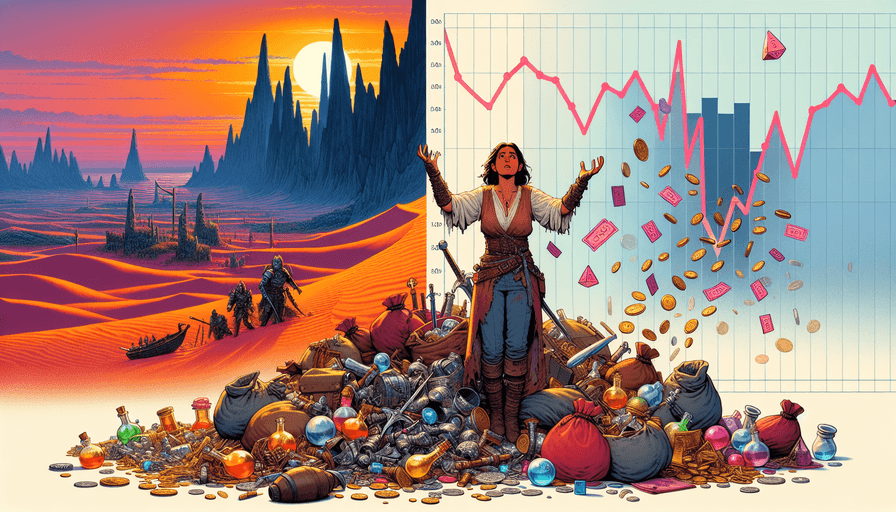
Pearl Abyss is learning the brutal lesson that every publicly traded creative studio eventually learns: the market doesn't care about your vision. Following the mixed critical reception at launch on March 19, the company's stock dropped nearly 30%, with an additional 9.78% decline the following day on March 20 — figures reported by the Korean business press. This, despite 2 million copies sold. This, despite sitting at number one on every major platform.
The irony is almost poetic. The game is commercially viable. By many accounts, it is genuinely impressive. And yet the moment critics posted scores below 85, investors ran for the exits. It's a reminder that in the business of entertainment, perception and reality operate on entirely different ledgers — and perception moves faster.
The Verdict
Crimson Desert contains multitudes — some extraordinary, some deeply frustrating. It is the product of enormous ambition and significant investment, and a quality control pipeline that clearly lost focus somewhere in the final stretch. Pearl Abyss has committed to rapid improvements, and given the sales figures, they have both the financial incentive and the community pressure to follow through.
Whether they deliver is a story for another week. For now, the game sits atop the charts, its developer issues apologies, its stock bleeds out, and 2 million players are somewhere in Pywel — wrestling with clunky controls, marveling at the scenery, and desperately searching for somewhere to put all this loot 1.