- Published on
When Billions Can't Buy an Acre
- Authors

- Name
- Sopha Kingtyred
- @kingtyred
There is a particular kind of stubbornness that resists easy accounting. It does not appear in a spreadsheet. It does not respond to a higher bid. It is the stubbornness of a person who has watched four generations of their family work the same soil, and who, when a stranger arrives with a briefcase full of zeroes, says: no thank you, and please don't come back.
That is precisely what is happening across rural America right now, and the consequences for the AI industry are, by any financial measure, significant — though the full picture is more complicated than any single number suggests.
The Knock on the Door
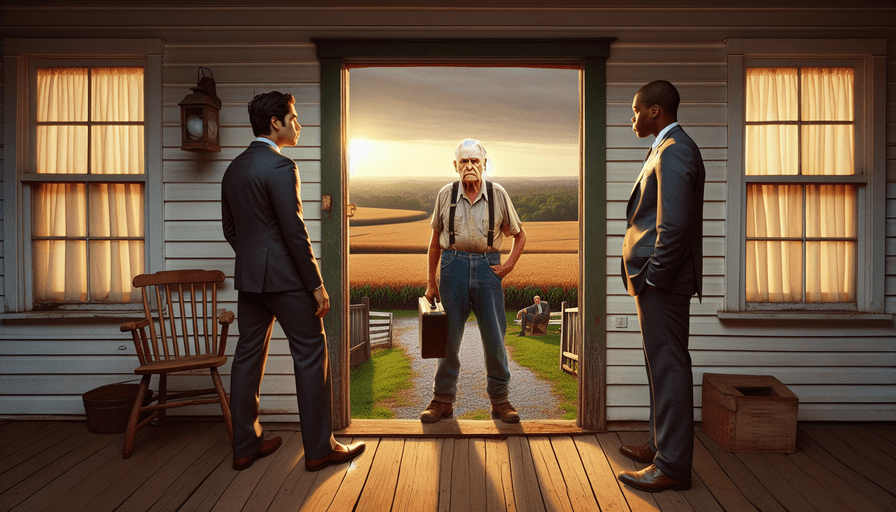
Ida Huddleston is 82 years old. She lives on 650 acres in Mason County, Kentucky, in a cabin her late husband built from local wood and rocks. Last May, two men arrived at her door representing an unnamed Fortune 100 company. They had a contract worth more than $33 million. They also had a non-disclosure agreement — she would have to sign it just to learn who was buying her land, or what they intended to do with it. Searching public records, Huddleston and her neighbors eventually discovered that a new customer had applied for a 2.2 gigawatt project from the local power plant — nearly double its annual generation capacity. The unknown company was building a datacenter. US farmers are rejecting multimillion-dollar datacenter bids
She sent them away.
"You don't have enough to buy me out," she told them. "I'm not for sale. Leave me alone, I'm satisfied."
Her neighbor, Dr. Timothy Grosser, received an $8 million offer for his 250-acre farm — a figure representing a 3,500% premium over what he had paid nearly four decades earlier. The developers returned with a follow-up proposition: name your price. His answer was two words: There is none.
The details of these encounters — the unnamed buyer, the NDA requirement, the sequence of offers — come primarily from the farmers themselves and from reporting by The Guardian based on interviews and public records searches. The offers, as described, appear to have been preliminary proposals rather than executed contracts, and at least some aspects of the process remain opaque by design, given the NDAs involved.
In Pennsylvania, 86-year-old Mervin Raudabaugh was offered $60,000 per acre — roughly $15.7 million total — for land he had farmed for more than six decades. He declined, and instead sold development rights to the Lancaster Farmland Trust for just under $2 million, guaranteeing the land would remain agricultural in perpetuity. "I was not interested in destroying my farms," he said. "It really wasn't so much the economic end of it." Farmer rejects $15 million data center offer
In Wisconsin, a farmer was offered between $70 million and $80 million for 6,000 acres. He turned it down. A neighbor, Anthony Barta, articulated what many in these communities feel but struggle to say: "Me and my family, we own the farm and run close to 1,000 animals. What would that do if that's next to it? That's our livelihood." Data center builders thought farmers would willingly sell land, learn otherwise
These are not isolated incidents. They are a pattern. And they are costing the technology industry in ways it did not anticipate.
The Scale of the Resistance
The AI infrastructure buildout requires land. A great deal of it. According to Hines Research, as cited in reporting by both The Guardian and Ars Technica, an estimated 40,000 acres of sites prepped and grid-connected for datacenter development are needed globally for new projects over the next five years — double the amount currently in use. The figure refers to land that has been prepared and made ready for power delivery, not merely land under option or in negotiation. Developers have descended on rural America because it offers what Silicon Valley values most in real estate: weak zoning protections, cheap power, and abundant water. 1
What the models apparently failed to account for was the people already living there.
The financial consequences of that miscalculation are now measurable, though the full picture is genuinely uncertain and the causes are plural. A February 2026 analysis by Sightline Climate estimates that 30 to 50 percent of the datacenter capacity expected to come online in 2026 may not be delivered on schedule — a projection that Sightline attributes to a combination of power availability constraints, permitting challenges, and organized local opposition, without disaggregating the precise contribution of each. Separately, research cited by Data Center Watch puts an estimated $98 billion worth of projects at delayed or blocked status in a single quarter of 2025 — a figure that reflects all sources of delay, including supply chain, financing, and regulatory obstacles, not community resistance alone. And reporting from The Guardian found that 26 datacenter projects were canceled in December 2025 and January 2026 alone, compared to just one cancellation in October 2025. Taken together, these figures suggest a significant disruption to the buildout timeline. But attributing the shortfall to any single cause — including community opposition — would be an overreach. What the data does support is that community resistance has become a documented, measurable variable in the buildout equation: one the industry did not adequately price in. Community Opposition Emerges as New Gatekeeper for AI Data Center Expansion
The resistance is no longer confined to individual farmers. It has metastasized into municipal governments, planning commissions, and courtrooms.
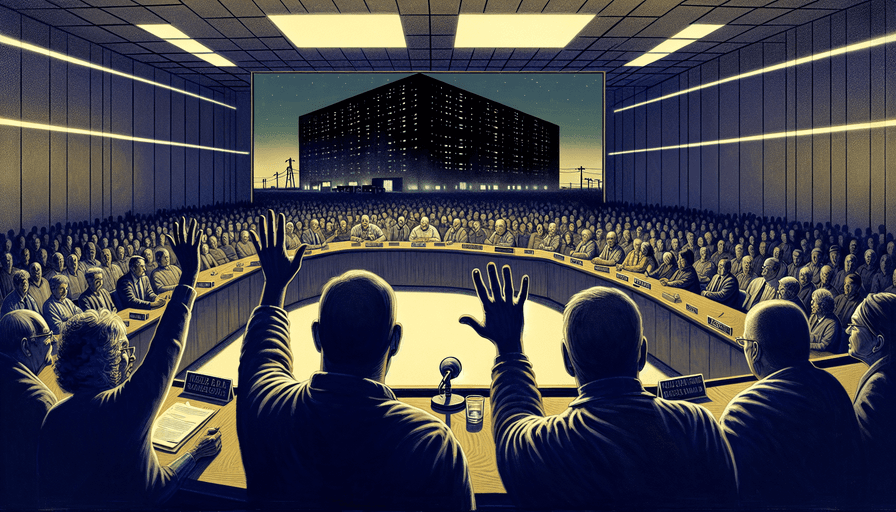
In February 2026, the San Marcos, Texas City Council voted 5-2 to reject a $1.5 billion datacenter campus proposed by Highlander SM One LLC — a reversal of its own 6-2 approval from January. The meeting ran nearly nine hours. More than 100 residents spoke against the project. A handful spoke in support. The council, apparently, did the arithmetic. San Marcos City Council rejects data center land plan
In Caledonia, Wisconsin, Microsoft sought to rezone 244 acres for a datacenter. Forty of the 49 people who spoke before the planning commission opposed it. Nine days later, before a vote could even be held, Microsoft withdrew. "Why do we have to subsidize a company making billions of dollars a year?" one resident asked. The question, it turned out, was sufficient. 2
In New Brunswick, New Jersey, the city council took a more preemptive approach: it removed datacenters as a permitted use from its redevelopment plans before a formal proposal was even submitted. Community opposition, in this case, did not react to a project. It eliminated the possibility of one. 3
The Legal Counteroffensive
The industry is not surrendering quietly. Where community opposition has succeeded, legal challenges have followed.
In Pennsylvania, Scranton Materials LLC appealed Ransom Township's denial of a datacenter zoning change in February 2026. The legal argument centers on a structural feature of Pennsylvania municipal law: municipalities are required to regulate for every type of lawful land use somewhere within their borders. A zoning ordinance that makes no provision for datacenters can be challenged as facially invalid under this standard. If a court agrees, the remedy can be significant — developers may be permitted to build with reduced local oversight, or the municipality may be ordered to adopt conforming regulations. Scranton Materials appeals Ransom Twp. denial of data center zoning change
This legal dynamic is real, but it is not an absolute veto over local control. Municipalities retain meaningful tools — conditional use approvals, noise and water standards, setback requirements, height limits — that can shape how and where a datacenter is built, even where outright prohibition is legally precarious. The Pennsylvania framework constrains the most blunt forms of exclusion; it does not eliminate the capacity to regulate rigorously.
"In Pennsylvania, all municipalities must regulate for all uses or be sued and have their zoning ordinance declared invalid, and then they can build it wherever they want," explained Brigitte Meyer, staff attorney for PennFuture. "Saying no is not an option. And local governments cannot impose moratoriums." She was careful to add, however, that municipalities retain the authority to regulate noise, water impacts, and other conditions of development — and that having robust regulations in place before an application arrives is the most effective posture. 4
The practical implication is sobering: communities that believe they have won may discover the victory was temporary. But the more important lesson, according to legal practitioners, is that the fight should happen before the application arrives — not after.
In response, advocacy groups and planning commissions are scrambling to arm municipalities with regulatory tools. PennFuture has produced a 27-page model zoning ordinance covering minimum lot sizes, a maximum building height of 45 feet, mandatory sound and vibration studies, water feasibility requirements, and emergency response plans. Chester and Montgomery counties released their own model ordinance this month. At least 16 pieces of datacenter-related legislation are currently pending in Pennsylvania's legislature. 4
The emerging consensus among legal experts is that the most effective strategy is conditional use methodology — a framework that gives elected governing boards the authority to impose binding conditions on any approval. "You're not a data center expert," said Doug Borgerson, borough manager of West Conshohocken, "but you're an expert in your town and what your town needs." 4
Meanwhile, Hays County Judge Ruben Becerra proposed a moratorium in Texas on industrial developments consuming more than 25,000 gallons of water per day. "Our stewardship of water — the very lifeblood of our community — cannot be reactive," he said. "It must be a proactive vow to protect what we cannot live without." 5
The Politics of Inevitability
For years, the datacenter industry operated with the quiet confidence of the inevitable. Bipartisan political support — President Biden traveled to Wisconsin in May 2024 to promote Microsoft's $3.3 billion project; President Trump attended the Foxconn groundbreaking in 2018 — created an atmosphere in which local resistance seemed more like a speed bump than a barrier. 2
That atmosphere is changing.
The economic development argument remains potent in struggling rural communities. Mason County's industrial development director Tyler McHugh framed the choice in terms that resonated with local officials facing population decline: "We can continue to shrink — losing population, losing jobs and watching our young people leave for opportunities elsewhere — or we can chart a new course." The proposed datacenter, he noted, would bring 1,000 construction jobs, though only 50 permanent operational positions. That ratio is not unusual. McKinsey research, cited in CNBC's reporting on the Wisconsin disputes, found that a 250,000-square-foot datacenter could employ roughly 1,500 people during construction but more than 50 for steady-state operations — a pattern that holds across the industry, where construction workforces can number in the thousands while permanent staffing rarely exceeds 50 to 100 full-time employees. 2
Developers and their advocates argue that the economic case extends well beyond direct employment. In Loudoun County, Virginia — home to "Data Center Alley," through which roughly a fifth of the world's internet traffic passes — datacenter tax revenue nearly equals the county's entire operating budget. The fiscal argument carries real weight in communities where the alternative is continued population loss and shrinking tax bases. That said, the net fiscal picture is not always as favorable as headline tax figures suggest: infrastructure costs, emergency service demands, and water system upgrades can offset revenue gains, and local fiscal analyses vary considerably by jurisdiction. 6
But organized grassroots opposition is increasingly capable of overwhelming the economic argument. Montgomery County Vice Chairman Neil Makhija acknowledged as much: "Locally elected officials are the ultimate deciders on whether or not data centers land in their community." 4
And some of those officials are being reminded, at 3 a.m. after nine hours of public testimony, exactly who elected them.
There is also the matter of coercion. Farmers who refuse to sell have been warned by utility companies that eminent domain — the government power to seize private property for public use — may be invoked. The threat is not hypothetical. Dominion Energy used it against a Virginia farmer in April 2025. The specter of the government compelling a sale that the market could not close adds a dimension to these disputes that goes well beyond economics. 6
Developers, for their part, have not been silent. Some have offered water reuse commitments, noise mitigation plans, and community benefit agreements as conditions of development. The industry's case — that datacenters bring tax revenue, high-wage construction employment, and connectivity to communities that have long been left behind economically — is not without merit. What has changed is that communities are now scrutinizing those claims with far more rigor, and finding that the terms often favor the developer.
What Money Cannot Measure
The resistance to datacenter development is, at its core, a collision between two entirely different ways of calculating value — and while that collision is not purely emotional, it does involve something that standard financial models are not built to capture.
For the industry, value is fungible. Land is land. A high enough number makes any exchange rational. The assumption embedded in every offer — from $8 million to $80 million to "name your price" — is that there exists some threshold at which a person will say yes.
For the farmers who have said no, that assumption is simply wrong.
"My whole entire life is nothing but the land," Ida Huddleston said. "It's provided me with anything and everything that I've needed for 82 years." Her daughter, Delsia Bare, who has lost most of her vision and now relies on birdsong and the sound of a running creek to connect with the farm, fears a datacenter's hum will sever that last thread. "There's a bond with the land. There's no way to undo it. That's family, that's history." 6
Rural sociologist Mary Hendrickson at the University of Missouri describes farmland as something "somewhat irreversible." If ceded to industrial development, it destroys what that land could be for agriculture — permanently. The farmers who understand this are not being irrational. They are being precise. 6
There are also environmental concerns that extend beyond the personal. PFAS contamination — so-called "forever chemicals" — has been raised as a potential risk of datacenter construction. Jonathan Kalmuss-Katz, an attorney with environmental nonprofit Earthjustice, has stated publicly: "We know there are PFAS in these centers, and all of that has to go somewhere. This issue has been dangerously understudied as we have been building out data centers, and there's not adequate information on what the long term impacts will be." The precise pathways by which PFAS compounds might be used in or released from datacenter operations — whether through fire suppression systems, cooling infrastructure, or other mechanisms — are not fully established in the public literature, and the claim warrants further independent research before firm conclusions can be drawn. What is well-founded is the call for more rigorous study. Data center builders thought farmers would willingly sell land, learn otherwise
And the broader agricultural picture is bleak. The United States lost approximately 15,000 farms in 2025 alone. Farm bankruptcies soared. Tariff disruptions, elevated borrowing costs, and suppressed crop prices have placed enormous financial pressure on exactly the communities being targeted by datacenter developers. That farmers are declining transformative offers under these conditions is not a curiosity. It is a statement.
Conclusion
The AI boom was premised, in part, on the assumption that physical constraints could be solved with sufficient capital. Power? Build more. Chips? Order more. Land? Pay more.
That premise is being tested in the kitchens and town halls and courtrooms of rural America, and it is not holding — though the reasons are multiple, and community resistance is only one of them.
The $98 billion in blocked or delayed projects, the 26 cancellations in a single two-month stretch, the 30 to 50 percent capacity shortfall projected for 2026 — these are not rounding errors. But they reflect a convergence of constraints: supply chain bottlenecks, permitting gridlock, power infrastructure limits, financing conditions, and, not least, communities that have declined to be moved. To pin the shortfall on any single cause would be too simple. What the evidence does support is that community resistance has emerged as a new and durable variable in the buildout equation — one the industry demonstrably did not price in, and one that is now reshaping where, and whether, major projects move forward. 3
Mervin Raudabaugh, who spent six decades farming in Pennsylvania and turned down $15.7 million to ensure his land would remain a farm, put it with the precision of a man who has thought about it for a long time: "It breaks my heart to think of what's going to take place here, because only the land that's preserved here is going to be here. The rest of every square inch is going to get built on. The American farm family is definitely in trouble." 7
He is probably right about both things.
Footnotes
US farmers are rejecting multimillion-dollar datacenter bids / Data center builders thought farmers would willingly sell land, learn otherwise — The 40,000-acre figure is attributed to Hines Research, as cited in both sources. It refers to land globally prepped and grid-connected for datacenter development over the next five years. ↩
Community Opposition Emerges as New Gatekeeper for AI Data Center Expansion ↩ ↩2
Model data center zoning ordinances coming to the fore ↩ ↩2 ↩3 ↩4
US farmers are rejecting multimillion-dollar datacenter bids ↩ ↩2 ↩3 ↩4